SYS/LP
One page, one goal, one number.
Landing page design: conversion, A/B testing, and SEO
A landing page is one page, one goal, and one number to move. We write the structure and copy for conversion, integrate cleanly, wire tracking, and test variants until the rate moves.
Landing page design is part of our Digital Products expertise — prototyping, SaaS, and landing pages.
SYS/FOR
Who it's for
Paid campaign pointing to the homepage
Sending an ad to the homepage dilutes intent: you need a dedicated page, aligned with the ad, and a single goal.
Product or event launch
A short window, a single message, a sign-up form: the landing has to convert from the first visit.
B2B leadgen
White paper, demo, webinar: capture the right lead without scaring people off with a form that's too long.
When the page is just one link in the chain, we plug it into a B2B lead generation system: qualification, CRM, follow-up.
SYS/SCOPE
What it covers
Six work streams. Expand a card to see exactly what's inside.
Conversion structure and copy
Message, proof, and call to action ordered for the goal — not a brochure, a page that decides.
What you get
A promise at the top of the page, proof right behind it, a single call to action repeated. On Infirmière Reconversion, the hero CTA captures 70% of the page's traffic: it's that order that decides, not the length of the text.
Mockup and integration
Design then integration in Webflow or HTML/Tailwind, clean and fast to iterate on.
What you get
A responsive page, reusable components so the next variant takes hours, and the tool chosen based on who will maintain it: Webflow if marketing needs to keep control, HTML and Tailwind if performance or product integration come first.
Form and tracking
A calibrated form and measured conversions (GTM, GA4) so you know what works.
What you get
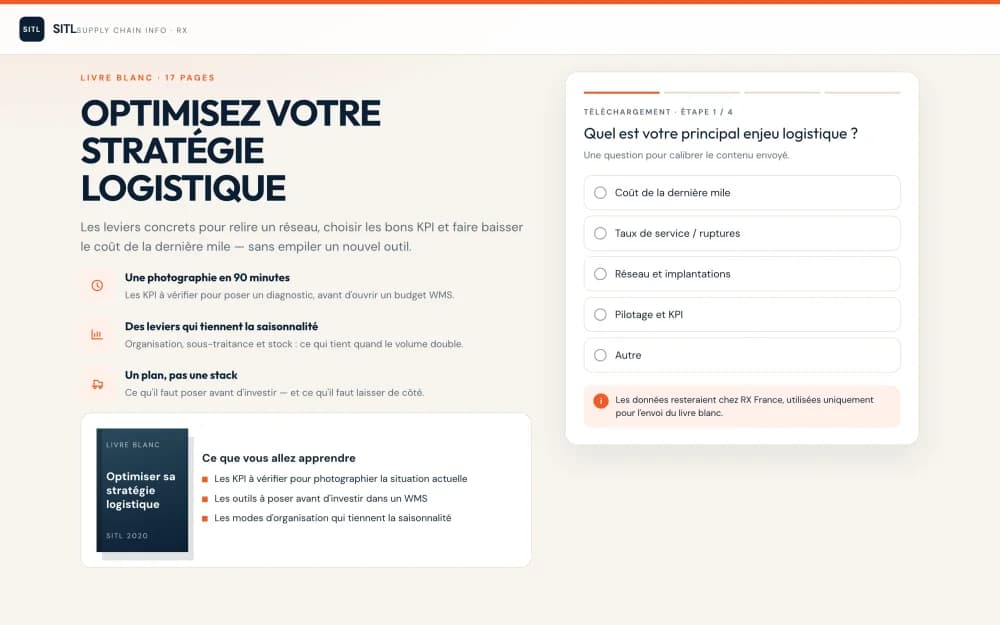
Every field is justified or removed, and every step is measured. This is the work that took SITL's white-paper form completion from 27% to 45% — +66% completed submissions at constant traffic.
Template A/B tests
Structure and CTA variants put into test until statistical power is reached.
What you get
Two or three strong hypotheses at a time, a test run to significance, and a decision owned in both directions. On an A/B test analyzed for an airline, the verdict was not to ship: −2.25% relative, significant at over 99%.
Performance and on-page SEO
Speed, tags, and Core Web Vitals taken care of — a fast LP converts and can rank.
What you get
Sized images, controlled fonts, no library loaded for nothing, titles and metadata written for a real intent. A fast landing serves paid — cost per acquisition drops when the page loads — and stays eligible for organic.
Paid variants
Variants by audience or by channel, consistent with the ads that feed them.
What you get
One page per message rather than one page for everyone: Institut Cassiopée received 9 landing pages dedicated to paid traffic, for +65% conversion on that traffic and +22% engagement.
SYS/AI
What AI changes here
Agents multiply the hypotheses to test instead of a single frozen idea: more copy and structure variants, a first heuristic audit roughed out automatically. Sorting and final writing stay human.
Before
We used to write one version of the page — the one defended by the most convincing person in the meeting — and put it live. Producing a second full structure cost enough that we simply didn't — so we weren't really testing, we were shipping an opinion and watching the number move without knowing why.
A single hypothesis
One page = one implicit hypothesis, never formulated, never confronted with a serious alternative.
Rare variants
One page per audience stayed a luxury: paid pointed to a generic page, for lack of production time.
With agents
The cost of a variant collapses: we formulate several structure and message hypotheses, we produce them all, and we let the test decide. That's what makes a setup like Institut Cassiopée's 9 paid landing pages viable — one per message rather than one for everyone.
Variants
Copy and structure variants generated then put into a real test — we decide on the data, not the loudest opinion.
Assisted audit
A heuristic audit of the page (friction, clarity, hierarchy) is roughed out by agents, then reviewed and arbitrated by hand.
What stays human
Choosing the page's single goal, writing the promise, and reading a test result without telling yourself a story. A variant can lose: the work then is to write “we don't ship” and start over, as on the A/B test analyzed for an airline (−2.25%, significant at over 99%).
The promise
What the page promises, to whom, and what it refuses to promise: an offer decision, not a copy decision.
Reading the test
Statistical power, real effect, decision to ship or not. An agent produces the variant; it doesn't sign the verdict.
SYS/LOOP
How we work
A short loop, one number to move.
- 01Scope the goal — one goal, one number — define what the page must move.
- 02Write and mock up — conversion structure and copy, agent-assisted variants, reviewed.
- 03Integrate and track — Webflow or HTML/Tailwind, form, GTM and GA4 wired in.
- 04Test and iterate — template and CTA A/B tests, keep the winner and run again.
SYS/TOOLS
Tools
- Webflow
- HTML / Tailwind
- GTM
- GA4
- Heatmaps
SYS/FAQ
Frequently asked questions
Webflow or code?
Webflow lets you iterate fast and leave control with marketing after delivery. Custom HTML / Tailwind wins when performance, product integration, or an imposed design system come first. We choose based on who will maintain the page afterward.
MoreLess
This isn't a stack war. A paid LP that changes every week should be editable. A comparison page glued to a SaaS should live in the product code.
The studio does both. The call is to avoid slapping Webflow everywhere “because it's simpler,” or code everywhere “because it's more noble.”
One landing page per campaign?
Yes, as soon as the message or audience changes. A page aligned with its ad converts better than a generic page — that's the logic of Cassiopée's 9 paid LPs, and the same principle as the SEA lever.
MoreLess
Agents speed up variant production. We don't create a factory of orphan pages: every LP has a goal, tracking, and a possible end-of-life date.
The site homepage is not a landing page. Sending paid there is often the first hole in the bucket.
How many variants to test?
Two to three strong hypotheses at a time — offer, headline, structure — never ten micro color variations. We test what can move the number, until statistical power, with an eye on SRM.
MoreLess
Too many variants, not enough traffic: the test never concludes. Better a clear fight than a lab. The CRO detail is on the CRO page.
Agents produce variants fast. They don't decide to launch fifteen.
Can an LP rank in SEO?
Yes, if it's fast, well structured, and answers a real intent. A well-crafted landing serves paid and organic: Core Web Vitals, titles, internal linking, content that isn't just a slogan.
MoreLess
Not every paid LP is meant to rank. A one-week promo page, no. A “X software for Y” page, yes. We decide at scoping; we don't “add keywords” after the fact.
See the SEO lever for the content cluster; here, we're talking about a conversion URL that can also be an organic door.
How does a landing page improve conversion rate?
By aligning promise, proof, offer, CTA on a single intent, cutting leaks (too-rich nav, links to the homepage, kilometer-long forms), and taking care of mobile and speed. It isn't “more blue.”
MoreLess
We instrument from integration: events, conversions, sometimes an A/B. An LP without measurement is a flyer. A measured LP enters the CRO program.
Social proof, objection, reassurance: we place them where the journey breaks, not as décor under the fold out of habit.
Are responsive and speed still a topic?
Yes. A growing share of paid and organic arrives on mobile. An LP that “sort of works” loses conversions before the offer even shows. Speed (image weight, scripts, fonts) is a CRO lever as much as an SEO lever.
MoreLess
We don't sacrifice the page to an animation. If motion serves the message and holds the perf budget, yes; otherwise, no. It's a trade-off, not a demo.
Eco-design here means less weight, not a label to stick on. Fewer kilobytes, more pages that hold up on an average network.
Do you need a dedicated designer?
Not for a scoped conversion LP: the studio designs and integrates. Strong art direction, a brand campaign, a shoot: that's where a dedicated creative makes sense, as a pair.
MoreLess
We're not a “freelance webdesigner to redo the whole site” offer. We're a studio that makes pages that convert, often inside an ads program or a CRO test.
If you have brand guidelines, we follow them. If you don't, we set a sober, readable page, not a full identity in passing.
How do you instrument an LP?
Tracking plan, GTM, click / submit / conversion events, consistency with the ads account. Without that, we don't know if the page “works.” See Analytics.
MoreLess
Agents help place the tags and verify. The event list is decided with you: few, stable, named once.
An LP delivered as “we'll wire tracking later” isn't delivered.
SYS/NEXT
Next step
Send us the ad, the offer, or the page to rebuild: we'll identify the first conversion lever and the test to launch. Written scope within 48h, no commitment.
The other levers of Digital Product Design